
Common Laser Welding Defects: Causes and Solutions?
Laser welding uses a high-energy-density laser beam as the heat source; by controlling parameters such as laser pulse width, energy, peak power and repetition rate, the workpiece melts and forms a specific molten pool — an efficient, precise welding method. To date laser welding has been widely adopted across many industries: electronic components, automotive manufacturing, aerospace and other
manufacturing fields. Even so, laser welding still inevitably produces some defects and substandard parts. Only by fully understanding the defects laser welding can bring, and mastering the solutions, can we meet higher process requirements.
So what are the common laser welding defects, and what are their causes and solutions?
1. Undercut
Undercut is a groove or depression in the base metal along the weld toe, caused by improper parameter selection or incorrect operating method.
Undercut defects fall into three quality grades:
General: defect depth not greater than 1.5 mm
Medium: defect depth not greater than 1.0 mm
Strict: defect depth not greater than 0.5 mm
Causes of undercut:
Improper operating method or incorrect welding specification — welding current too high, arc too long, wrong electrode movement or angle, dwell time at the groove sides too long or too short — all can produce undercut.
Solutions:
1. Control the welding current and welding speed of the laser welder
2. Keep the arc length moderate
3. Apply the correct electrode movement method and electrode angle
2. Weld concavity
Weld concavity is the pit formed when the metal is heated too long, the welding current is too high, or other conditions cause the plate to sag downward.
Causes of weld concavity:
1. Assembly gap too large and root face too small, so the molten pool is large and the liquid metal sags under its own weight.
2. Electrode diameter or welding current too large; slow arc extinction or continuous arc welding raises the pool temperature and slows cooling, so the weight of the pool metal increases while surface tension decreases.
3. Incorrect electrode angle weakens the arc pressure on the pool metal, or the electrode does not reach the root of the groove.
Solutions:
1. When welding one side to form both sides, choose a suitable root face, angle and gap, and operate skillfully and accurately.
2. Strictly control the arc heating time for penetration and the electrode angle; keep the keyhole size appropriate and use a short arc.
3. Porosity
Porosity is the cavity left in the weld when gas in the molten pool does not escape before the metal solidifies. The gas may be absorbed by the pool from outside, or generated by reactions during the welding
metallurgical process.
The main cause is rust, oil or dirt on the surface of the base or filler metal; electrodes and flux that are not dried increase porosity, because the moisture in rust, oil, electrode coating and flux
decomposes into gas at high temperature, raising the gas content of the hot metal. Too little welding heat input cools the pool too quickly for gas to escape. Insufficient deoxidation of the weld metal also increases
oxygen porosity.
Solutions:
1. Remove oil, rust, moisture and debris from the wire, the groove and nearby surfaces.
2. Use basic electrodes and flux, and dry them thoroughly
3. Use DC reverse polarity with a short arc
4. Preheat before welding to slow the cooling rate
5. Weld with a slightly stronger specification
That laser welding produces defects is beyond doubt, but a good machine will certainly reduce product defects.
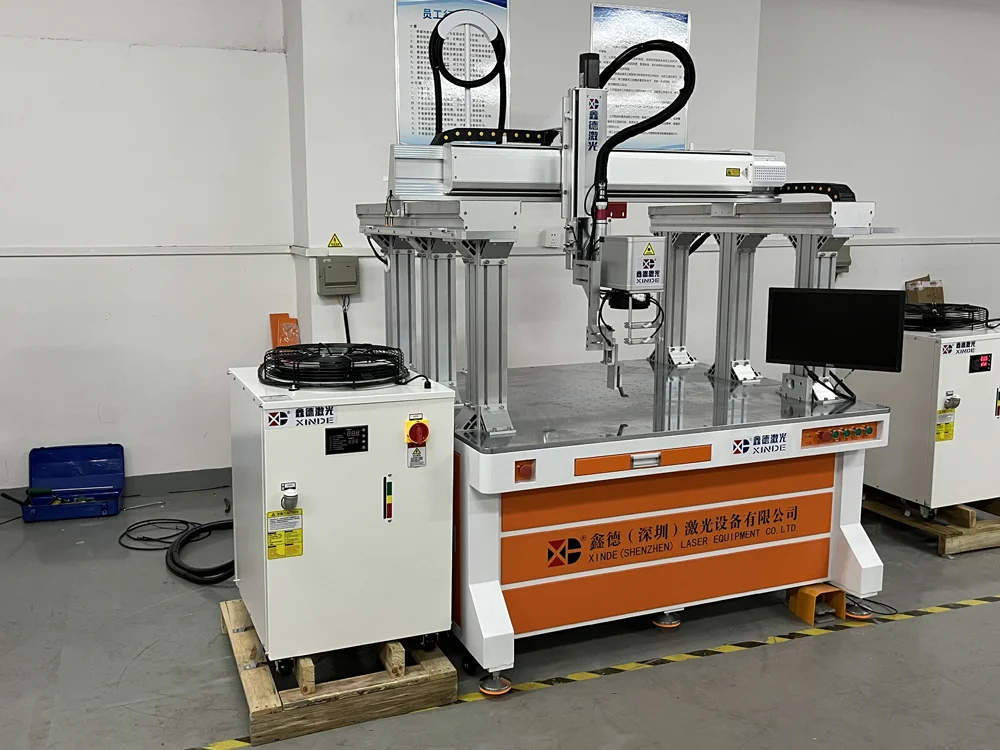
Xinde (Shenzhen) Laser Equipment Co., Ltd. is a high-tech enterprise integrating R&D, manufacturing and sales of industrial laser equipment. Its R&D team is made up of senior professionals from the new energy lithium battery equipment industry, and Xinde Laser welding equipment has clear advantages: fine weld spots, deep penetration, high precision, smooth weld surfaces free of bubbles and excellent weld quality.