
New Energy Lithium Battery Pack Line Smart Manufacturing Expert — Xinde Laser
Electric vehicles are one of the main themes of current social development, and countries are competing for the strategic high ground of new energy vehicles.
As a smart manufacturing expert for new energy Pack production lines in the new era, Xinde Laser has developed an automated production line for prismatic and pouch Pack modules.
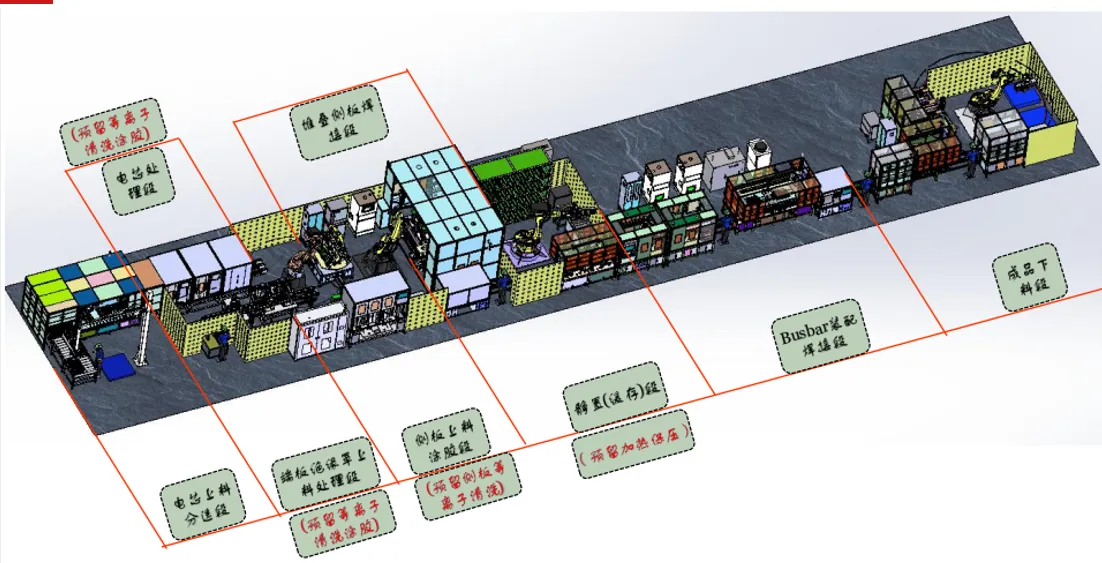
Station 1. Manual Loading
The process begins with manual loading. Cells are taken out of the box by hand and placed on the belt conveyor, which transports them to the gantry table. The gantry table consists of YZ dual axes, and the gripper is
equipped with a fixed code reader and a probe for voltage and internal-resistance testing. After testing, the cell is judged NG/OK, and upon completion it is transferred to the NG/OK channel.
Station 2. Manual Taping
Cells flowing down from the upstream OK belt are taken off manually for taping. After completion, they are laid down and placed on the upper belt line, waiting for stacking.
Station 3. Manual Stacking
After the taping station is completed, cells flow down and are manually taken and stacked on the line.
Station 4. Manual Labeling
From the lift table, the first station of the line body serves as manual module labeling, so as to record data for subsequent polarity detection, laser welding and post-weld inspection.
Station 5. Pre-weld Polarity Inspection of Module
After entering the vision recognition station, vision recognition photography is performed to eliminate welding problems caused by an incorrect positive/negative electrode sequence. Its advantages are accurate monitoring, stable data, and inspected data
uploaded to the host computer, enabling detailed real-time data monitoring.
Station 6. Side Plate Welding
The grouped cells transferred from the stacking station are placed into the squeezing station and the side plates are positioned. After the squeezing station is set, the robotic arm performs side plate welding. After welding, the squeezing station
resets and the robotic arm transfers the module onto the conveyor line.
Station 7. Terminal Welding
After the aluminum busbar is placed, the blocking cylinder releases it and the module moves forward to the welding position. The welding sensor detects a module to be welded, the lifting cylinder raises the tray, and once raised
it sends a welding signal to the laser welding machine. Then the vision equipment captures features to improve welding accuracy. After capture, laser welding is performed.
Station 8. Withstand-Voltage & Internal-Resistance Test
After aluminum busbar welding, the post-weld withstand-voltage insulation test is performed. The principle is to apply a voltage higher than the normal operating voltage to the insulation of the device under test for a specified period of time;
the voltage applied only produces a very small leakage current, indicating good insulation. After passing the test, the product can be unloaded for final pre-market inspection.
Station 9. FPC Welding
After terminal welding, two stations are reserved as FPC welding preparation stations, which can be changed according to customer requirements. The galvanometer laser welding head delivers high welding speed and high precision.
Station 10. Balanced-Boom Unloading
After post-weld visual inspection, the module flows to the rear lift table. Since the module is heavy, manual unloading would impose excessive daily labor intensity, so a balanced boom is used to grip and unload it; after unloading,
the lift table descends and sends the tray into the lower double-speed chain, delivering it to the front lift table.
Xinde Laser specializes in new energy lithium battery laser welding equipment and Pack automated production lines!